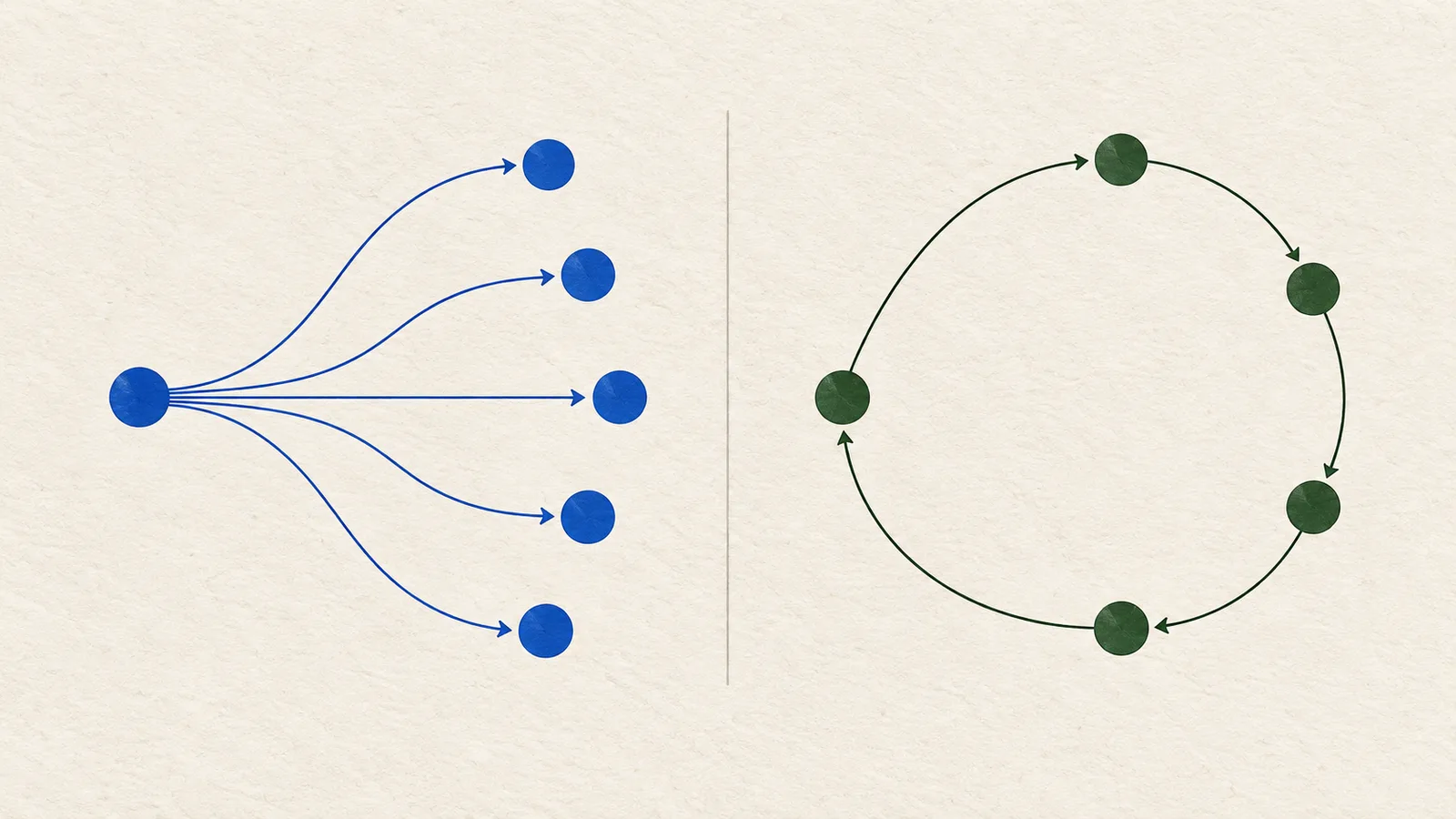

Rule-based automation applies a specified condition and action. AI-assisted ad management may interpret several signals or propose a less rigid response. The meaningful comparison is not which sounds smarter; it is whether the system acts within clear authority using reliable evidence.
Separate observation, recommendation, approval, and execution. A tool can be excellent at summarizing a problem without being authorized to change a live campaign.
Compare the decision being delegated
A rule such as “notify the owner when spending exceeds an agreed threshold” has a narrow, inspectable purpose. A request such as “improve campaign performance” leaves many choices unresolved: which goal, what budget, what risk, and which changes are allowed.
| Question | Rule-based system | AI-assisted system |
|---|---|---|
| Decision logic | Explicit condition and action | May interpret context or generate proposals |
| Review need | Validate condition, timing, scope | Validate evidence, reasoning, scope, and proposed action |
| Failure risk | Wrong threshold or stale input | Those risks plus unsupported interpretation |
| Essential control | Authorized bounded action | Authorized bounded action |
These categories can coexist. An AI system may recommend a threshold while a deterministic control enforces a spending limit. Do not assume that an AI label means every part of the system is adaptive or autonomous.
Ask what evidence precedes a change
The system should identify the account, campaign, data period, freshness, and business outcome behind its recommendation. It should distinguish observed results from estimates and state what it cannot verify.
Test how it handles missing data. A disconnected reporting source should not become “zero conversions” and trigger a sweeping pause. Delayed conversions should not be silently treated as completed poor performance.
Require a way to inspect proposed changes before execution where the workflow calls for approval. A button labeled “Autopilot” is not a sufficient explanation of what authority the business has granted.

Check controls, not only recommendations
Define permitted accounts, action types, budget ceilings, approval owners, and a stop mechanism. Confirm how the system responds when an account changes owner, access is revoked, or the operator disables automation.
Google's automated-rule tools provide rule status and logs, with documented limits on undo behavior. This is a reminder to verify the actual recovery mechanism rather than assuming every automation is instantly reversible. Google's rule-management documentation.
Even a reversible campaign change can spend money or interrupt delivery before it is reversed. Preview and auditability reduce uncertainty; they do not make live actions consequence-free.
Run a bounded evaluation
Begin with a clearly defined observation or recommendation task. Compare the output with source data and the business's operating rules. Introduce live authority only through an explicit, limited scope and a verifiable approval process.
Ask the provider to demonstrate a failed action, an unknown result, and a retry. A trustworthy system should not repeat an uncertain financial or campaign action merely to discover whether the first attempt succeeded.
Judge the result by useful decisions and verified outcomes, not the volume of recommendations. For Omesta, evaluate the current connected-account workflow and approved controls rather than assuming any feature described here is included automatically. Explore Omesta’s AI ad-management workflow.
How Omesta helps with keeping recommendations separate from permission
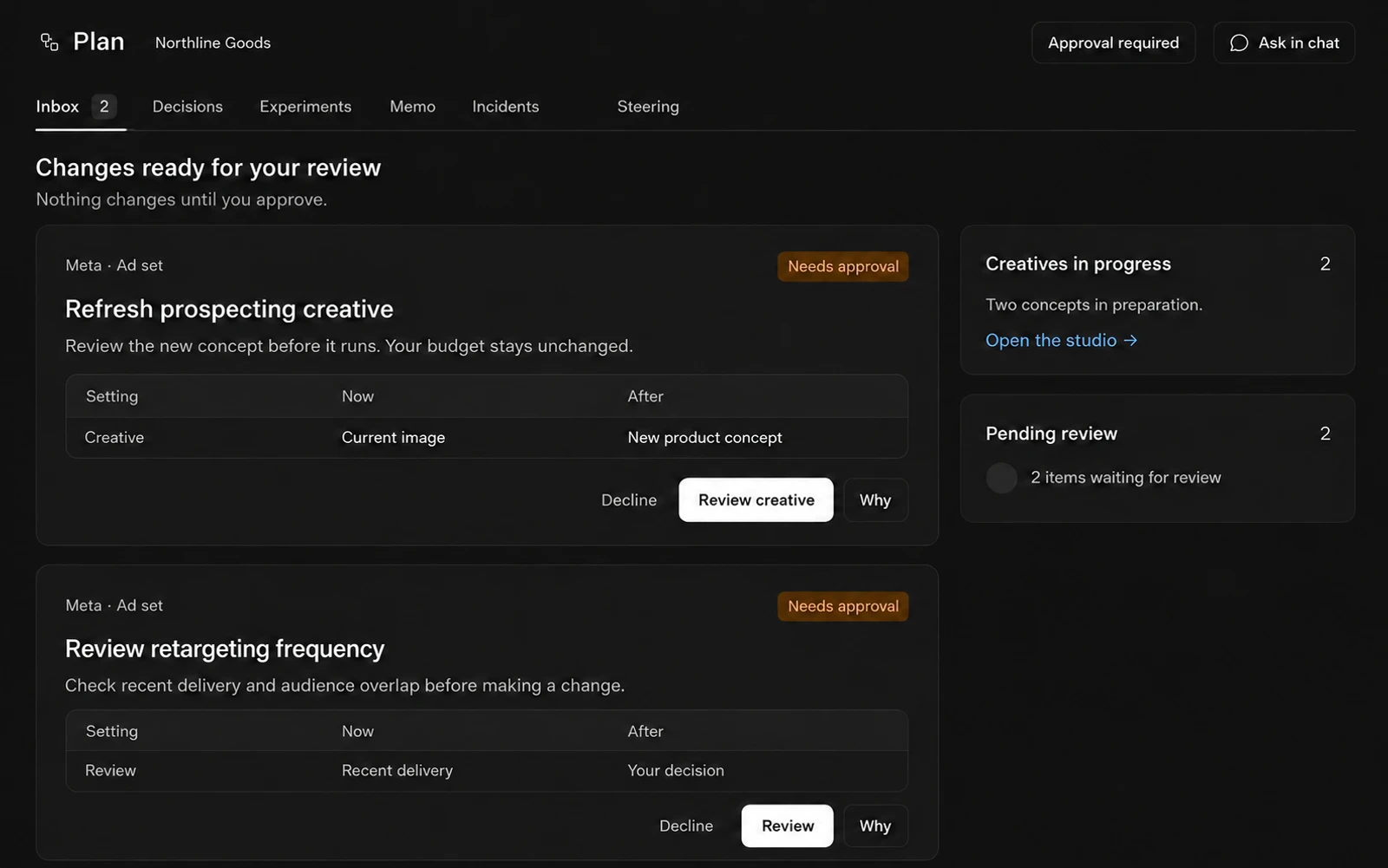
Omesta’s agent-assisted review can help you examine account evidence and prepare the next decision. Its current ad-change workflow requires approval before supported changes. That gives your team a defined review point rather than treating the word “Autopilot” as unlimited authority. Evaluate the actual connected workflow and plan limits before delegating work.
Explore the AI ad-management workflow for current capabilities and the pricing page for plan limits.
Frequently asked questions
Are rules safer than AI?
Not automatically. A poorly scoped rule can repeatedly make harmful changes. Safety depends on evidence, authority, limits, monitoring, and recovery behavior.
Should AI be allowed to change budgets immediately?
Only within the business's explicit approved scope and controls. A recommendation or an accessible account is not permission to spend.
How do I compare vendors?
Ask each to demonstrate the same bounded task, including missing data, approvals, logs, and failure recovery. Evaluate what actually works rather than the autonomy promised in a demo.