
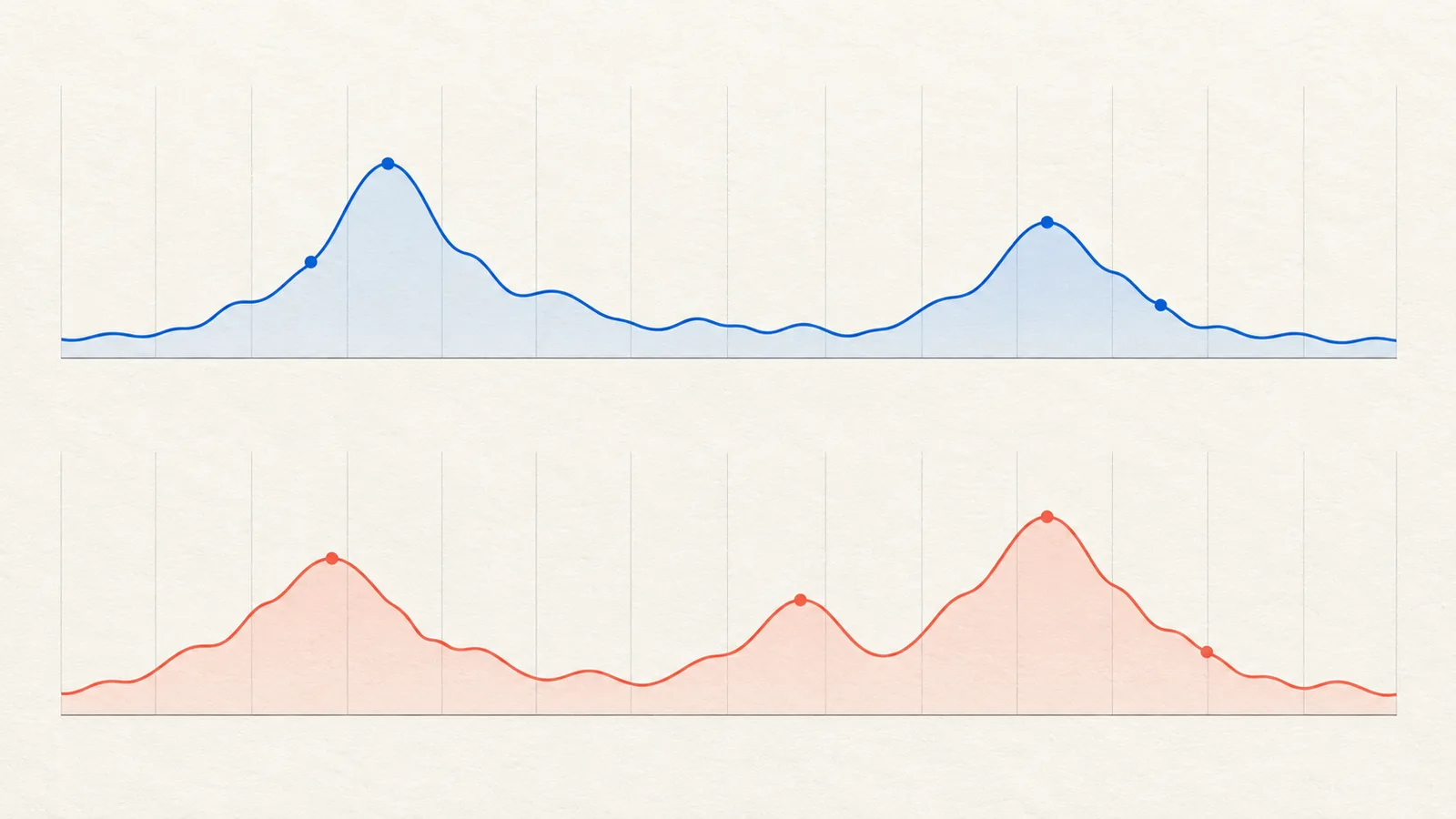
Branded searches include your business or product identity; non-brand searches describe a category, problem, or service without naming you. Report them separately when evaluating acquisition so people already seeking your business do not obscure how you reach unfamiliar prospects.
The distinction is useful, but it is not a complete explanation of incrementality. A branded query is not proof that an ad was unnecessary, and a non-brand query is not proof that advertising created demand from nothing.
Write a classification rule
List the actual business name, product names, and recognizable variants that belong in the brand group. Review ambiguous terms manually. A company name that is also an ordinary service word may not reveal brand intent by itself.
Keep competitor-name searches separate where they matter. They are neither your own brand demand nor necessarily generic category demand. Avoid assuming that three simple buckets capture every customer's intent perfectly.
Use available search-term evidence and explain its limits. The report does not expose every underlying query, so a classification can include an unknown or unclassified share rather than pretending to cover all traffic.
Compare like-for-like outcomes
| Reporting field | Why it belongs in the comparison |
|---|---|
| Spend and inquiries | Shows observed acquisition activity |
| Qualified opportunities | Adds business fit |
| New versus existing customer | Separates acquisition from repeat demand |
| Query classification | Makes the demand context explicit |
| Outcome window | Prevents comparing immature and mature cohorts |
Use the same qualification rules across groups. A branded caller asking about an existing appointment is not a newly acquired prospect merely because an advertising platform recorded a call conversion.
If your branded campaign appears much cheaper, ask what demand it is capturing before moving all spending toward it. Its available audience may be limited by awareness generated elsewhere.
Do not confuse attributed credit with caused growth
Attribution assigns credit among measured interactions according to a model. It does not by itself establish how many customers would have arrived without advertising. Google's documentation explains attribution as distributing conversion credit across interactions. Google's attribution-model overview.
Consider the hypothetical customer who hears about your business from a friend and later searches its name. A paid click might receive credit for the inquiry, but the report alone cannot separate the friend's influence from the ad's incremental contribution.
That uncertainty does not justify abruptly stopping campaigns. If the business needs a causal answer, design an appropriate controlled test, considering geography, seasonality, demand, and sample size. A simple before-and-after chart can be affected by all of those.
Use the split to improve decisions
Look at non-brand queries to understand which services and questions bring unfamiliar prospects. Review brand activity for accurate messaging, customer support confusion, and the relationship between paid and other demand sources.
Record any structural campaign changes so the trend remains interpretable. Do not compare a newly reclassified report with an older blended report without rebuilding or explaining the baseline.
For the customer-cost layer, see CPL versus CAC. For current reporting, keep a stable monthly report definition rather than changing categories to improve the headline.

How Omesta helps with keeping acquisition questions distinct
Use campaign reporting as the starting point for a brand-versus-non-brand review, and maintain your classification rule separately. A shared view can make it easier to discuss which demand a campaign serves. Omesta does not automatically prove incremental lift or classify every search term according to this guide; those conclusions require their own evidence.
Explore the AI ad-management workflow for current capabilities and the pricing page for plan limits.
Frequently asked questions
Should brand and non-brand always be separate campaigns?
Separate reporting is valuable, but the appropriate campaign structure depends on control needs, volume, and the platform configuration. Classification and structure are different decisions.
Are branded conversions all returning customers?
No. A new prospect can learn your name before searching. Verify new-customer status from business records rather than assuming it from the query.
Is non-brand ROAS the only number that matters?
No. Evaluate the whole acquisition system while preserving useful distinctions. A single channel ratio cannot explain every source of demand.